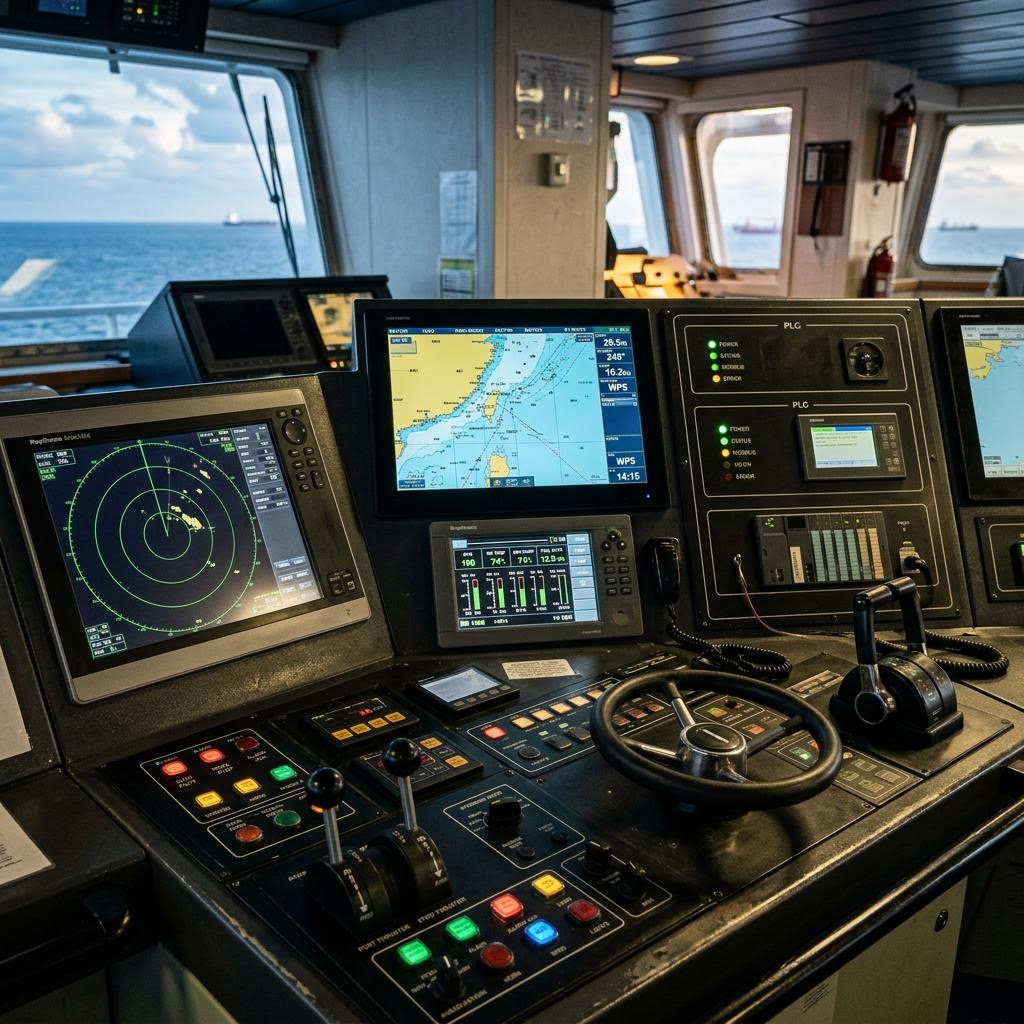
Control systems built around the application
The real question is what the vessel or equipment needs to measure, decide, control and communicate. WTM works across the control layers between field equipment and operator to build systems around the application.
A PLC, HMI or I/O system is only part of the answer.
The real question is what the vessel or equipment needs to measure, decide, control and communicate.
WTM works across the control layers between field equipment and the operator to help create systems around the application rather than around a particular piece of hardware.
When standard control isn't enough
When requirements grow — more sensors, more equipment, more communication, more operator visibility — the challenge moves from hardware selection to system structure.
- Another machine needs to communicate.
- Equipment moves away from the main panel.
- A new function is introduced.
- Or an existing controller reaches its limit.
At that point, the challenge is deciding how the system should be structured.
Many applications begin simply.
- Then another sensor is added.
- Another machine needs to communicate.
- The operator needs better visibility.
- Equipment is moved away from the main panel.
- A new function is introduced.
- Or an existing controller reaches the limit of what it was designed to do.
At that point, the challenge is no longer choosing a PLC.
It is deciding how the system should be structured.
Start with what the system needs to achieve
What information is available?
Which sensors, instruments and devices are providing information to the system?
Where is the equipment located?
The physical vessel layout can determine whether central or distributed control makes more sense.
What decisions need to happen automatically?
Good control logic reflects the operating requirement rather than simply automating every available signal.
What does the operator need to see?
Too little information creates uncertainty. Too much creates noise.
What needs to communicate?
Control systems often need to exchange information with third-party equipment rather than operate alone.
From field signal to vessel function
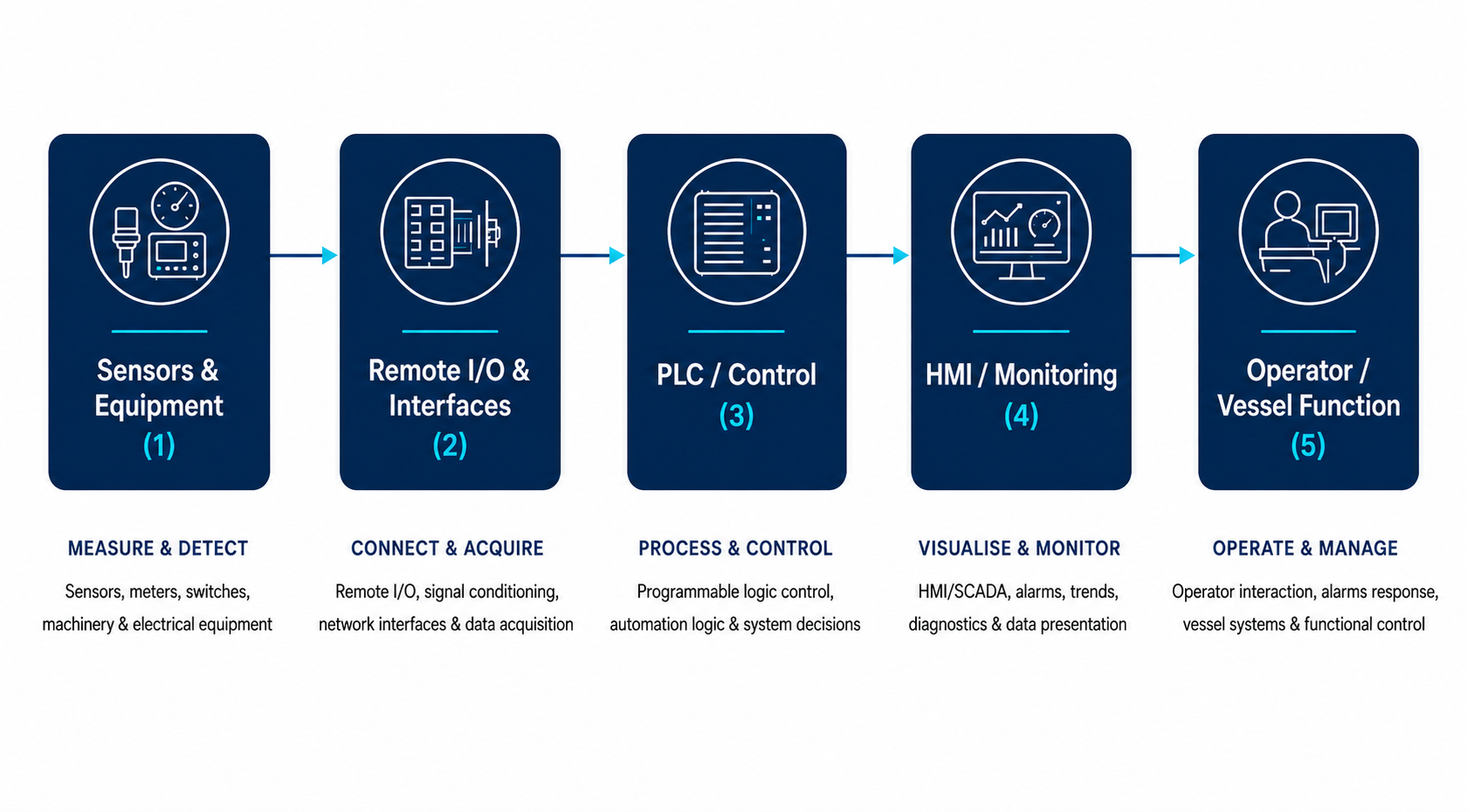
A control system is a chain — the quality of the result depends on each layer and the interfaces between them.
A control system is a chain. The quality of the result depends on each layer doing its job and the interfaces between those layers being understood.
Technical Architecture
From field signal to vessel function.
A fault or design issue at any one of these points can affect the way the entire application behaves. That is why WTM approaches control systems as connected layers rather than isolated products.
Five layers. One connected system.
WTM works across all five of the layers that typically sit between field equipment and the vessel operator. Each layer has a distinct role. Each interface between them needs to be understood.
The controller is only useful if the logic matches the application
PLC control coordinates machinery, signals, interlocks and sequences. Quality depends on the I/O structure, field devices, communications and operator requirements — not just the controller itself.
PLC control can coordinate machinery, signals, interlocks and operating sequences across a vessel or equipment package. But the quality of the system depends on more than selecting the controller. The I/O structure, field devices, equipment response, communications and operator requirements all shape how the control system should behave. WTM can support PLC-based control where the application needs more than independent electrical functions.
Put the I/O where the signals are
Distributed I/O reduces long cable runs where equipment is spread across the vessel. Whether it makes sense depends on the application, environment, communications and service requirements.
Not every field signal needs to travel back to one central cabinet. Where equipment is spread around a vessel or machine, distributed I/O can reduce long cable runs and create a more practical system architecture. The decision depends on the application, environment, communications and service requirements. WTM can work with distributed I/O where it makes sense as part of the wider control system.
A measurement only matters if the system can use it
Level, pressure, temperature and other measurements have to reach the controller and be interpreted correctly. WTM works across the interfaces between instrumentation, I/O and the control system.
Level, pressure, temperature, position, speed and other measurements often sit at the edge of the control system. The instrument may be working correctly, but the signal still has to reach the controller, be interpreted correctly and trigger the expected response. WTM can work across the interfaces between instrumentation, I/O and the control system.
Different equipment still has to speak to the same system
Modern vessel equipment increasingly communicates digitally. WTM supports the control-side integration of equipment where industrial communications — Ethernet, fieldbus or equipment-specific protocols — form part of the solution.
Modern vessel equipment increasingly communicates digitally. That can simplify wiring and provide much more information — but only when the interfaces between systems are understood. Industrial Ethernet, fieldbus and equipment-specific communications may all exist within the same application. WTM can support the control-side integration of equipment where communications form part of the solution.
Know what changed before guessing what went wrong
A well-designed monitoring system makes clear what is happening, what is failing and what needs attention. WTM assists with HMIs, operator panels and monitoring that turns signals into useful information.
Alarm systems and monitoring interfaces provide the critical link between the control logic and the vessel operator. A well-designed system makes it clear what is happening, what is failing and what needs attention. WTM can assist with HMIs, operator panels and monitoring systems that turn raw signals into useful information.
The value is not the PLC. It is what the system does.
Speak to WTM about the application first. The hardware should follow the requirement.
Discuss a Control Requirement